How to understand this blog

Showing posts with label surviving history. Show all posts

Saturday, December 31, 2011

the year in review

I really don't feel like writing a "Yay 2011!" blog post because it just wasn't that kind of year. I am fervently wishing for a better 2012 and happy to see this year slide into history in about 28 minutes, NZ time.

The year for me was dominated by the earthquakes.


February 22 was a horrible, dark day, one of the worst days of my life, and it threw everything into its shadow for a while. I couldn't even imagine feeling happy or carefree again for quite some time. I've always been a let's-fix-things-quickly kind of person, and it's been a hard adjustment to start thinking in terms of the years it will take before things come right in Christchurch. And then there's the fact that, whenever it feels like things are starting to be happier and more positive, another large-ish earthquake comes and knocks us over again and we're all Over It with a capital O and I.

So this year has been pretty sucky, to use the technical term.

And yet ....


1. I (finally) finished my thesis. Now that I've had a chance to sit back, breathe, consider it - I'm proud of what I produced. I was so dazed and confused by it all by the end of my part in the process - it shows in my face, in the photo above - that I'm amazed, looking back, that the thesis made sense at all.

I don't know if I mentioned this before but the process still continues. You may remember I wasn't particularly over the moon with my results... and it turned out in the end, after I inquired further into the rationale behind the grade, that I may have grounds to appeal it. The university's academic committee will be considering the issue in January, but it may mean another marker is appointed and my grade will be reconsidered. So I feel happier about the situation.

2. It took me some months to find a job after uni. It was difficult to see if everything was going to work out, but I'm glad I hung in there. I got to do some short-term work that was very interesting and very different, for me, and I even got to be published for my work on a book about a robot language as a result!! It was hard work making ends meet with no long-term solutions in sight, but it was truly an exercise in learning to trust God, trying my hand at new and random things, and learning to live simply and frugally.

3. I got my first "proper" job and am now a member of the public service, working in the recovery effort for Christchurch and its surrounds. I absolutely love my job and this has been the true highlight of 2011. I am so grateful for a job that allows me to use the skills I've been trained in, challenges me, and allows me to help in the recovery from the earthquakes - this is something I'm passionate about. I can't believe I've been so lucky.
With the career came the car, which I can finally afford to keep, and independence!

4. 2011 gave me a new niece who is now six months old, incredibly cute, and a blessing to our family.


5. 2011 also gave me new flatmates who became some of my best and closest friends, and consolidated my strong friendships with the flatmates I had lived with previously. Something about going through the earthquakes together brought us closer than ever before, and I am so grateful for the lifelong friendships I believe we have formed. It's so great living with people with whom you can laugh, cry, support, be supported, philosophize, play the clown, understand. Again, I've been very lucky.
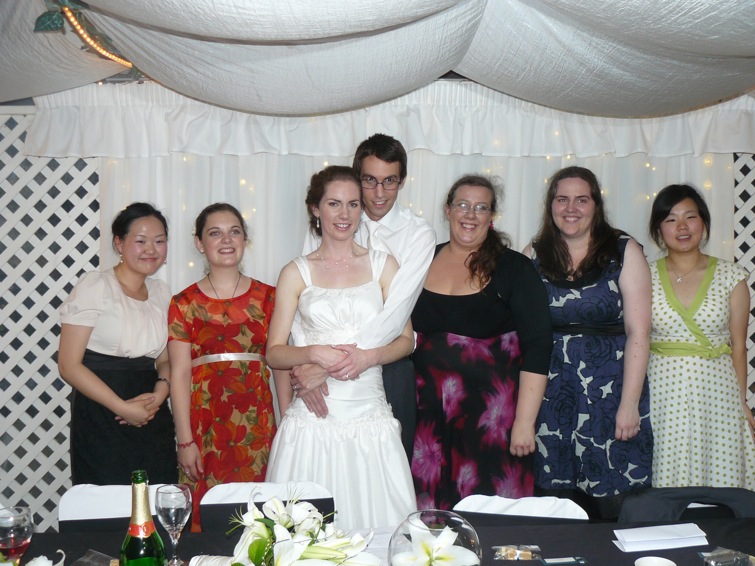
Here we are, above, at my flatmate A.'s wedding, earlier this month, which was another highlight of 2011. R. and I have seen the whole story of A.'s romance with J. unfold, and it was so special to be at the wedding and celebrate with them, if also slightly bittersweet because it is the end of three jampacked years of flatting with A. who is a wonderful, crazy friend!


6. The final highlight of the year for me was escaping to Dunedin with the family for Christmas and to Mt Cook, above, for a few days afterwards. More on this later. Suffice it to say it was a healing and happy time!

And as I finish this blog post it is two minutes past midnight. Happy new year! Please, 2012, be good to us.

Thursday, December 8, 2011

lightning and rain


I was on a trip with my music group when I was 13. It was one of those surreally cinematic moments, and the first time I'd ever seen a REAL lightning storm like fireworks across the sky. It was also probably quite dangerous, but who cares? I'm here to tell the tale.

I am glad I did this because it's the sort of thing I would totally put on my "Things To Do Before I Die" list if I had not in fact already done it. It's going on my "Things To Do Again" list now.

Friday, August 19, 2011

survive history

Apparently, ASTONISHINGLY, the phrase "surviving history" did not originate with me. I've been playing on Google, originally because I'm so vain that I wanted to see where my blog appeared on the list of websites containing the phrase "surviving history"...

... except I don't think I ever found out. I got distracted by some of the intriguing entries that (deservedly) appeared well above me on the list.

Surviving History: Portraits from Vilna
This blog is about a project which is documenting the experiences of 10 Holocaust survivors in Lithuania. It talks about the exhibition currently touring outside Lithuania - read more about it here. It interviews survivors like Gita, and it talks about the problems they faced after the Holocaust and still face today. It talks about Lithuania's problems with anti-Semitism, Holocaust revision and the ultra-nationalists, and it discusses why this stuff still needs to be discussed. It links to info about other crimes against humanity around the world. Very impressive.

The Hebrew Bible Contains the Oldest Surviving History
Unfortunately you can't read the whole article unless you're a paid-up member, but the start of it is fascinating all the same. It challenges our perception of writing our own histories as an obvious thing to do across cultures. Interesting notion!

Surviving History: the TV show
Well, I don't know about you, but I didn't realise this show existed until now. History Channel crossed with Mythbusters, exploring the different ways humans have tortured or attacked or killed each other. Charming. Here is a clip about the history of hanging as a method of execution. I wish people didn't have to do this thing where they construct a safe, fake replica of something horrid from the past and claim to be finding out exactly "what it felt like". No. No, you don't. Hopefully you will never know what it feels like to be hanged or tortured or executed in any way.

Wednesday, August 10, 2011

picking sides

I wrote this blog post a while ago, and since then have been sitting on it for a while. I wasn't sure if it was a good idea to publish it because it's very ranty, and not exactly in the normal style of this blog. So be warned - it deals with controversial stuff, and I am clearly quite upset about some things. The boat may be rocked.

Let's make a deal. Just in case you read this and disagree, and just in case any comments get heated. I promise not to deal any differently with you than I normally would. I respect the people who read this blog, I respect that we have differences of opinion, and I will continue to read YOUR blogs with pleasure. I would love if you could continue to read mine without judging my normal blog posts by what you may disagree with in this one.

--

I am going through a phase of feeling completely cynical about politics. (I know it's not exactly abnormal.)

I've always seen myself as a left-winger. I generally like left-wing people who argue about things better than right-wing people who argue about things. I love the idea of a society that recognises the contribution of the working class to wealth. I really, really love that I live in a country with a public health system that tends to work and is available to everyone. I like that if I am ever in deep financial trouble I probably won't have to go and live on the street. I like unions.

I'm not a fan of the Right. It is so fixated on the economic rights of the individual that it tends to ignore the masses and their need to, you know, eat. Its theory is that, by allowing individuals to accrue unlimited wealth, society will be more generally wealthy as an inevitable result. It seems to assume that people with lots of money will automatically be charitably-minded, responsible people who are brimming over with integrity. Ha!

I still feel this way about these things.

However, I'm growing less and less convinced that either Left or Right or anyone in between or on the extremes has a clue how to cope with difficult problems. The centrist/right-wing party in charge at the moment hasn't exactly fixed anything in the last few years they've been in power (to be fair, they aren't responsible for the financial problems of the global economy). On the other hand, the Left is almost cartoonish, bleating the same old song - "Tax the rich!" And what? All our problems will be solved? Recently, the Labour Party leader claimed that he would raise the minimum wage and this in itself would create more jobs... really?! I'm not a right-winger but, even so, this does not exactly compute.

It also bugs me how the Left has a penchant for saying that if you're one of us you need to feel the same way about every single issue. A few left-wing blogs I've been following lately have told me that because I believe that abortion is a violation of human rights I am therefore a man, socially conservative, a supporter of the war in Iraq, and a member of the right wing. If it helps you to ignore my objections by persuading yourself of that... well, please enjoy your bubble.

I'm beginning to think that the Left, over the last century or so, has a major problem. We TALK in terms of the masses. Social justice for all. Human rights. But actually we're all about picking sides, demanding justice for our half and delivering oppression on the other.

Lenin and Stalin and the international Communist movement were very open about this. It was the working class versus the capitalist oppressors, and it was a class war. And so only the rights of the workers have any weight whatsoever, and everyone else can rot in the gulag or be liquidated in purges. Stalinist or Maoist or Leninist crimes have been well known for a long time now, and the non-Communist Left rightly dissociates itself from them. Heck, even the Communists do so.

All the same, the non-Communist Left falls into the same trap when it starts arguing that, because it feels intense sympathy for one particular group of individuals, it's okay to ignore the rights of other individuals.

To fall pregnant, when you don't want to be pregnant... I feel sad thinking about this. It would be horrible. I'm not sure how to emphasise this without coming across a little trite, but please believe that women in this position have my full sympathy.

However, this in itself is not a wildcard to ignore the humanity of an unborn child. Demanding an end to this sad situation through abortion is another symptom of this mentality of picking-sides. As long as justice is done on ONE side, then it's okay that a human life is taken on the other.

Would anyone seriously question the humanity of a foetus if it were not for the fact that they want to have the freedom to abort it if it appears at an inconvenient time? Or if it were not for the fact that the state would prefer not to spend money on a child with a birth defect, who needs extra care, education, and support?

To call that child a parasite is just as unjust as calling the children of the Russian Tsar parasites who deserved to be murdered. It's just as unfair as exiling to forced labour and probable death the children of a peasant who happened to own a cow and was therefore a "rich" kulak.

And to tell ME that it's none of my business if an individual or a society decides to take someone else's life from them is a statement that has been made by a string of evil tyrants. It should never be received unquestioningly.

It's easier to get away with arguing that a foetus is not a human, because you can't see this unborn child. You can argue that, because it's not "normal" or it looks different to us, it doesn't have human rights in the same way we do. It's also easy to persuade yourself that it's okay because none of the people taking part in the debate will ever be threatened with this kind of "termination" (a word that bears a frightening resemblance to "liquidation", in my opinion). We have all made it out of the uterus, and therefore we are safe from this particular threat.

What happens, though, when WE become inconvenient? When we are in a car crash and lose control of our bodies? When we become elderly, frail, senile? By explaining away the rights of the individual in one case, will we have weakened our support of human rights in all cases?

And are we really comfortable, in the modern world, with saying that the worth placed on an individual by society defines their right to live or die? Are we comfortable with saying that an individual who has Down's Syndrome should not have made it out of the womb? And why - because they're not normal? They don't fit in with the majority of people? They don't "contribute" to society? It's offensive, isn't it. And yet it's the constant implication.

Our system has made us believe that we have to choose one or the other. The rights of the woman or the rights of the baby. By picking one or the other, we are buying into a system that degrades both. We need to change the system. Make it value pregnant women, support them, provide them with financial and emotional help. Make it value the vulnerable of all ages. Zero tolerance for discrimination in the workplace or society at large for women who are pregnant. Et cetera.

The inevitable response to my objections is usually that, if I really cared about the foetus, I would care about the foetus post-birth. That OBVIOUSLY the majority of abortions in New Zealand and elsewhere are undergone for selfless reasons - because the pregnant woman knows she wouldn't be able to provide the right kind of life for her child.

Firstly, here we have again the assumption that I am a rabid right-winger and don't want to vote for governments that will provide support for single mothers or families who live in difficult situations. I am not that person. Actually, I will almost always vote Labour or even lefter.

Secondly, the obvious retort is that we would not use the same logic about other humans in society. We don't kill criminals who have not been reformed because they will probably cause suffering when they leave prison and have an unhappy life. We are horrified and angry when the lives of infants and small children are taken away from them, no matter what sort of economic circumstances or family situation they were affected by.

We believe these things because we've seen these people, we've talked to them, they've had a chance to talk to us. We want to live in a society that gives everyone a chance to make what they can of what they've been given.

We believe that life is a Good Thing, an opportunity, and no one should be able to take it away on behalf of someone else because they think someone else will be better off that way - what narrow-minded arrogance!

We just seem to forget this, when it happens to be an unborn human. Maybe it's because it would be too inconvenient. Maybe it's because we can't see them, and they look different to us. Whatever the reason, I've had enough of this convenient blindness.

Friday, July 22, 2011

30 years today

The Springbok tour of New Zealand began on July 22, 1981. The South African rugby team came to our shores while most of the rest of the world refused to take part in any sports competition involving the country which still held onto apartheid. What's more, our rugby officials decided not to put any Maori players into the All Blacks team just in case it was offensive to the sensitive white Springboks players.


I would like to think New Zealand has learned something from the tour. I hope it has, anyway, but feel slightly pessimistic.

It's so strange for me to admit that rugby is not just a game. The rugby world cup is coming to New Zealand this year and I am so thoroughly fed up with rugby-mania and misplaced national pride that I just want to scream with my hands in my hair - "IT DOESN'T MATTER!"

And yet professional sports are not just a game. Apartheid was not a game. I wish I could feel confident that the lessons of history are being learned, but if so how are we to account for the Beijing Olympics of 2008? The relentless disregard of basic human rights is not a game. Learn the lesson, New Zealand.

Monday, July 11, 2011

alasdair and john

New Zealand was the first country in the world to give women the vote. Hurrah! For some reason I've ASSUMED for some time now that that must mean our men are slightly ahead of the rest of the world when it comes to enlightenment.

Over the past few weeks we've been given a chance to see that that is spectacularly not the case. A few males in powerful positions have made some outlandish statements that have shocked the country - and so in some ways, of course, the reaction to these statements is evidence that many men feel very differently to them. But in other ways, too, it has become very obvious that a large number of men feel very sympathetic.

Back in the days of the women's suffrage campaign, this was the kind of criticism women were up against:

A frightening, domineering archwife lowering the dignity of Parliament. Emotional and uncontrolled, she is clearly unsuitable to guide the country with rationality and restraint.

The picture has changed rather a lot now. But, for two relatively high-profile men, these ideas linger.

(1) Alasdair Thompson, who has had to resign from his position as CEO of the Employers' and Manufacturers' Association (EMA), recently defended the gender pay gap, claiming that women take much more leave than men - an obvious example being maternity leave, a slightly less unnecessary example being "monthly sick problems". Eugh.

As inappropriate and thoughtless as this statement appeared to be, Thompson proceeded to dig himself a deep, deep hole. He appeared in a couple of TV interviews in which he behaved in a completely bizarre way, promised "satistics" and then produced anecdotes, and pretty much acted like someone who has no idea how to conduct himself in public. You can read about it, or watch the full interview, here.

Had a great time on twitter reading other people's comments on the issue, some of which have been recorded here.

One of my favourites was from someone calling themselves "Alasdair_at_EMA": 'I am being completely misquoted. I have not mentioned anything regarding menstruation. Period.'

Another @RyanSproull: "Women are actually paid less because they spend hours crying and gossiping and asking for directions."

Another @teh_aimee: "Dear Alasdair Thompson. People _all over the world_ are currently having to rehinge their jaws."

I have to admit to feeling a little sorry for Mr Thompson after he lost his job and became the butt of the country's jokes. He's obviously completely clueless rather than intentionally malicious, and he's probably a nice old man who dandles his grandchildren on his knee - definitely no domestic tyrant. But the things he said and the way he said them, as if they were perfectly obvious (again, see the TV interview) ... well, it became very clear that feminism still has some pertinent things to say to NZ culture.

So I thought that was it for a while - until...

(2) The marketing director for our very own slightly far Right political party, Act, came out with some comments so damaging that even the Act party had to get rid of him. Taken from this article.

John Ansell began with racism, criticising "white cowards" for not taking action against the "Maorification" of New Zealand. (The Maori being the indigenous people of this country.) He thinks that Maori get special treatment, and has compared the situation to apartheid.

Yuck.

This is the main focus of people's criticism of Ansell, and rightly so, I think. Couldn't help noticing one of Ansell's comments, though:

Act is "a men's party. I can't get them to agree to that but it's a party for men and women who think like men."

Great, here we go again. Then someone on twitter directed my attention to this comment thread which Ansell has been active on.

DPF: “I’d be fascinated to hear why ACT is not a party for women who think like women.”

The evidence of history, David.

The women who support ACT are not squeamish about speaking bluntly about rational issues (including racial issues). I respect them very much.

In short, they’ve got guts.

More typical women are less rational and more emotional. They’d rather preserve relationships than rock the boat. Is that not true? ... women, by a reasonable margin, preferred to cuddle the various minority groups and spend more of other people’s money on welfare that to take the hard economic decisions. These ‘soft mothers’ voted for short-term gain and long-term pain.

The ‘strong fathers’, also by a reasonable margin, voted for short-term pain and long-term gain. The rational ... approach.

Now of course I’ll be branded misogynist as well as racist. But again, I’m just pointing out the simple truth.

The soft mother model doesn’t seem to be universal. In Britain, women ‘got’ Margaret Thatcher’s bold approach (a woman who thought like a man if ever there was one).

But in New Zealand, when it comes to strong policies that actually allow the country to move forward, the girls let the side down. ...

Man, I love it when people claim "the evidence of history" or "I'm just pointing out the simple truth", without specific reference to evidence of any kind.

And yes, here we are again. Facing up against a really delusional man who cannot stop talking when he really should do so. Facing claims that any women who are womanlike in character are irrational and unsuited to take part in government or even to vote, if Ansell is to be believed.

It's amazing how much has changed since 1893. And yet it's amazing how much things have stayed the same.

(An interesting blog post on the political implications of people like Ansell - if you're interested.)

Thursday, April 28, 2011

the royal wedding

A friend on facebook - only 20 minutes ago, approximately - told me that he was going to "judge" me because I look forward to watching the royal wedding with a bunch of friends as we drink tea and eat scones and cucumber sandwiches.

Apparently, women have an "innate cultural interest" in watching weddings and in fairytale prince and princess stories.

BAD innate cultural interest! NAUGHTY innate cultural interest!

Bah! It makes me want to throw things. Who is he to tell me what I should or should not be interested in? Who is he to interpret my reasons for wanting to watch the royal wedding?

And here they are:

(1) It's a chance to see a spectacle that I absolutely agree is outdated. It's none of my business what the UK decides to do about the monarchy. If I were in the UK I may feel a little more personally aggrieved that my tax pounds were going to this family. But since I'm not, and since I rather enjoy relics of the past, I am looking forward to seeing something grand and interesting and over-the-top.

(2) It also happens to be a rather cheerful event. No doubt my friend would prefer me to be holding parties discussing events in Libya or Afghanistan like a serious person, or moping around feeling depressed about the state of the world, but I for one have had enough gloom and am going to take this opportunity to celebrate love/marriage and run wild with it. I've had a crappy few months and I want to do something frivolous and ridiculous, dammit!

(3) The royal wedding is a historical event which is going to be watched by a huge number of people all over the world. Firstly, as an historian-in-training, I feel I should be interested in things that people will look back on in the future. The debate stirred up by this may lead to much more debate, with huge effects on the political structure of the UK and the Commonwealth. I want to be able to say that I saw the event that started it. Secondly, I've always felt a slight jealousy of people who can say that they took part in events of huge popular consciousness. My father saw the first landing on the moon. My sister saw Charles and Diana's wedding. Both events they witnessed with millions of people all over the globe. They can say they were a part of it.

(4) I like William. He came and spoke at the memorial service for the earthquake victims on March 18 and he seemed genuinely moved by what has happened here. In his speech, he only said things that were empathetic, encouraging and kind. It meant a lot to many people that he would come so far, so close to his wedding. It created a huge amount of goodwill that no video message from the British Prime Minister could have hoped to equal. As an ambassador for Britain, William was very successful. I think it's great that the links between countries can be deepened by these kinds of exchanges. So yeah - I like him. He seems nice, unaffected, and in love with a nice-looking woman. I think he earns his keep. I wish him well.

So there.

(Sorry about the rantyness. I'm tired of being told how I should feel about things.)

Wednesday, December 8, 2010

2010

Last year, around this time, I wrote a blog post about the wonderful year I had just had. And 2009, for me, was wonderful. This year... not so much. I thought for a moment about writing all the things that annoyed me about 2010, and then decided that would be very painful for you to read. So here is my list of good things about 2010 that I decided it would do me good to remember. The funny thing is ... there turned out to be more of them than I thought. Huh. That taught me a lesson.

1. I started the year with a lovely, although brief, time with the family. All of my siblings were in Christchurch at some point over the summer, and there was even one day when we were all in town at the same time. This is rare, and precious!

2. I have good friends, and I have made new ones this year. Some of them got married, or engaged. One of my best friends returned last week after fifteen months abroad. The last time I saw her was in Poland. It's really good to have her back.

3. Finally, after several years of wanting to do this, I ran a singalong Sound of Music! I put a ridiculous amount of work into it because I was so ridiculously excited, and it was worth every hour spent painting recognisable scenes from the movie. A bunch of people came who were as ridiculously excited as we were, and a good time was had by all.

4. Slowly, I've been coming to terms with my thesis. I have felt, at times during this year, painfully stupid. I've felt like I've been losing control of it, that I'll never get it figured out, let alone finished. It's not finished yet. But that's getting closer. And I'm figuring it out. I have much more of a handle on the things I am arguing and writing about.
Perhaps, pain has been gain. Perhaps I can do anything?

5. Four issues of Halfway Down the Stairs in 2010, marking five years of publication. I wasn't sure if we were going to make it on the last two without our web design expert, who had to leave our editing team - but I think we have made it! I'm loving the way the 'zine is going. I'm very proud of it.

6. 2010 was the year of Tuesdays-with-my-nieces, R. and M. I had to have part-time work this year, and I was so lucky to (a) devote one solid, single day to it instead of having to break up several days of the week, like most students, and (b) "work" a job that involved spending time with two of my favourite people. I've enjoyed Tuesdays so much. It's involved a kind of creativity that is so different to thesis-writing but has rejuvenated me for the days spent in the office thinking and reading and writing.

7. I have a new nephew, who is two weeks old. He is healthy and charming and calm, and he is a beautiful addition to the family. I can't wait to see some more of him post-Christmas!

8. I moved into a new flat this year, a flat which is lovely and which is owned by lovely landlords. That in itself was a huge improvement on 2009.

9. Said flat has not always been the warmest place to live, especially for people who can't afford much heating, which has given me a new appreciation of heat! Therefore, the onset of summer is more enjoyable than it has ever been before!

10. 2010 has been a year of beaching it up. My flatmates and I discovered at the beginning of the year that we all love swimming at the beach, love it so much that we discover our inner children. Then, later this year, I discovered the joys of bonfires on the beach and fire juggling. Below is a photo of me! Me! Spinning things around in my hands that have fire on the end of them!

11. I'm a social person, in some ways, but I can be quite shy and I freak out a little (or sometimes a lot) about certain types of social things. I don't like the thought of big parties, I don't like the thought of things where I may be expected to dance in front of people! It usually means I make excuses and get out of going to things. This year I have made much more of an effort to go to things. It means I've had more moments of anxiety than usual. It also means that I've usually ended up having more fun, getting to know people better, trying things and finding out they're not that bad.
I've hardly cured my tendency to stress out. But I've become more determined to do things despite it.
12. I got to visit the three other major cities of New Zealand - one entirely paid for by other people, one on air points, and the other for very very cheap. I had a great time in each one, and one in particular (Wellington) completely exceeded my expectations.
13. I also went away briefly, to Duvauchelles with some friends for a nice weekend, and on the Tranzalpine train across the Southern Alps. Rather beautiful and relaxing.

14. Figuring out the concept of assertion. Ask and you will be given, seek and you will find, etc. I asked some publishing companies and they have given me free books to review. Hooray! This has been part of how I started my new blog.

15. I went to the U2 concert on November 25! It was unbelievably cool.

16. So many things to be thankful for, and still this year has been a hard one. The West Coast mining tragedy and the Christchurch earthquake were the big, obvious things. The earthquakes are still coming every day. It's not that pleasant. Surely I should have got used to them? Instead I'm just getting worse.

In a less dramatic way, this year has been slightly difficult for me when it comes to worry. I don't know what I'm going to do when I finish my thesis, I haven't had much money and I have absolutely no savings, we've had to find flatmates suddenly with very little notice and are still at this moment hoping to find a flatmate within the next couple of weeks, and there have been a few personal things that have just been so very unsettling.

In a peculiar way, though, I'm glad this year has been tough. I have had to lean on God so much more. He has provided for me in completely unexpected ways and I have had to learn to trust him in a way that I never had to when everything was settled and safe. It would be nice if I could just learn a lesson and stop worrying. I know that's not going to happen. But I'm very grateful to him that the lesson has begun.

Monday, November 8, 2010

horrid books

I've been reading some horrid books lately, books written leading up to the second world war, books supporting Hitler and justifying his policies against the Jews. At this stage there was no Holocaust but there was so much ugliness, and these are ugly books, written by horrid people. I don't really enjoy reading them.

When I was doing my research at the British Library last year, I asked to look at a few British Fascist journals, and was surprised to be told that I could, as long as I moved over close to the librarians' desk so they could keep an eye on me. I was surprised, but after I looked at the newspapers I understood. It could have been very tempting to many people to rip those papers up, they were filled with such foul thoughts. In the interests of preserving history I had no such temptation, but I could understand the urge.

It's not pleasant, but it is yet another way in which history has been brought alive for me, and in which my own motivations for doing history have been made clear. It really matters that someone reads these books, and reminds others about what we can become if we are not careful.

As an afterthought: This is just another reason why I'm concerned that the British Government has recently decided to cut 40% of its funding of its universities, specifically targeting the arts and humanities. [See Naomi Wolf's take on the matter here.] Because, apparently, science and technology are the only things that matter. Lip service will be paid to the crucial part the arts and the humanities play in our civilisation. Politicians will pretend that an insightful and honest interpretation of the past matters to them, and that history is not merely a tool for their own personal axe-grinding. And, meanwhile, people will not understand what happened, because there will be no money to read old things at the British Library.

Monday, October 25, 2010

the final stretch

I am determined to finish my thesis by Christmas.

This is going to take quite some work.

I have a meeting with my supervisors on Wednesday in which we are going to figure out the direction my work needs to go in. This is what one of them wrote in an email about reading the last few chapters I've written: ...the existence of some problems, along with the basic quality of the research and the promise of the project. We need a long and deep discussion, as some restructuring may be needed.

It was nice of him to remember to say something kind - but I could already tell, as I read through what I've written now, that it's far from perfect and that the structure doesn't really work. I wasn't going to say anything about it because I hoped maybe I was wrong, but it looks like I'm in for a hard slog, uphill.

At the moment, I just want it to be over. I think once I've had the meeting and we've brainstormed a bit and I'm full of ideas, I'll be rearing to go. For now, I read it over and over, I jot down problems, and I rely on:

- caffeine. Procrastibaking. Cake.

- repeating to myself in all moments of utter panic my sister's PhD motto, taken from Finding Nemo's Dorie: "Just keep swimming, just keep swimming..."

- laughing at my situation and reminding myself that every single other thesis student goes through this and at least it's not a PhD: see Lord of the Rings allegory here...

- taking moments to do things like fix my bibliography or my footnotes, write my acknowledgments, etc. Nice practical tasks that remind me that I will finish. One sweet day.

Saturday, July 24, 2010

hello, posterity!


As I write my thesis I'm very much aware of the generalisations I have to make about history. As academic historians (-in-training), we have to be very careful about writing in a number of disclaimers into methodology sections, accepting that we can't know everything about the past, and that the only sources we have are flawed, biased and incomplete. And that's okay. It doesn't mean we no longer have a responsibility to the truth; it just means that we are aware that "the truth" is elusive and sometimes multiple.

I love going through my old sources. Archives, which I didn't get to use much of for this project, are especially exciting when you see handwritten notes by or about the people you spend so much time thinking about. The newspapers I've researched are more exciting to me than today's, and I especially loved the big volumes from which the dust rose in a cloud as I tentatively turned a page. (One of my lecturers always wears an apron and a dust-mask when going to Indian archives, much to the amusement of everyone who sees her.) But they're always going to be limited. Mrs Bloggs down the street who was only really interested in her cat, or Mr Finnigan in the pub who expounded daily, drunkenly, on the exploits of politicians - they are lost to history (most of the time).

But it excites me to think that in the future, historians will have so much to work with on the internet, in the blogs, on forums, etc. Comment is so much freer on the internet, and while sometimes this is unfortunate (leading to abuse), it is very, very interesting, and I beg you all not to delete your blogs if/when you decide to stop writing them!

How do you feel about your blog being a potential mine of information to future historians? What are we writing about that will be plucked from obscurity for the purposes of their MA theses?

Monday, July 5, 2010

sea bass (among other things)

Oh, what sort of career am I plunging myself into? A pit of scrapping toddlers? I have been following the news surrounding Orlando Figes' fall from favour with a mixture of pleased amusement and an audible "ick".

Figes is a British historian of Soviet history, at Birkbeck College, who really is a wonderful historian. Unfortunately, he seems to have a little problem - competition. Orlando, Orlando. It's nice to share.

Figes started by posting negative reviews of other historians' books on Amazon. [Source]
Of Rachel Polonsky: This is the sort of book that makes you wonder why it was ever published.
Of Robert Service: This is an awful book. It is very poorly written and dull to read … it has no insights to make it worth the bother of ploughing through its dreadful prose.

All the while, unfortunately, his amazon username was "orlando-birkbeck". Oops!
Another oops - he reviewed his own book, The Whisperers:
A fascinating book about the interior lives of ordinary Russians … it tells us more about the Soviet system than any other book I know. Beautifully written, it is a rich and deeply moving history, which leaves the reader awed, humbled, yet uplifted … Figes visits their ordeals with enormous compassion, and he brings their history to life with his superb story-telling skills. I hope he writes for ever.
I'm almost tempted to break into applause. It's beautiful.

When Polonsky and Service raised objections, Figes retaliated immediately with threats of legal action. Then, when the fact of his username came to light, he blamed it on his wife. Sigh - it just makes me want to sit him down and reason with him. Eventually, he admitted that he did it, and claimed that he had been so traumatised by researching his latest book that it led him to behave irrationally. Yes, Figes, you are the victim here.

Well, all this kerfuffle in the dour world of academia was pleasant to observe for a while, until it became clear that all the historians who have chosen to comment on the issue have come across as equally silly!

Robert Service, for one. In an article for the Guardian, he manages to come across as particularly loony.

This is a matter that has broad implications for the public interest, as can be seen from the way I've spent my week. I got up last Sunday earlier than usual. Been doing that since the week before when Figes's lawyer started to correspond. Don't know why I thought I would sleep. My wife, Adele, and I went to an afternoon concert in Goring by the Thames where a piece by her composer grandfather, Claude Cover, was played. We could have done, however, without the traffic jam on the way back on the M4. ...

I wasn't sure whether I could stand the tension much longer, but at least we didn't seem to have to worry about holding on to our house and home. I had my book to write, a book about agents and commissars in the Russian revolution. Adele escaped to her yoga class on Tuesday – she's been brilliant while all this has been happening. I too needed an escape and went for a run over Walthamstow marshes. Strange absence of the police helicopter, though presumably that was not Iceland's fault. But elder daughter Emma was still stuck in Madrid, which was. ...

I found it difficult to believe that Stephanie Palmer had written the reviews. Few people whom I knew did. Most were inclined to think it was Figes himself but were scared of him and his legal letters. Anyway, why would any member of the Figes household want to squirt such venom into the Amazon system? Perhaps I was impulsive in raising questions about the anonymous reviews but I just felt that someone had to stand up to a bully. Meanwhile, Emma got back from Madrid. Brava! On Wednesday Adele cooked sea bass for supper and we were joined by younger daughter, Cesca.

Sea bass for dinner! Brava! Oh my! Poor Professor Service. It has been a tough week, and one that is particularly relevant to the public interest. He added, when Figes was found out, "I am pleased and mightily relieved that this contaminant slime has been exposed to the light and begun to be scrubbed clean."

Methinks someone has been studying Soviet history too obsessively. "Contaminant slime"? It's pretty much straight out of the pages of the Communist papers.

But Rachel Polonsky defends him:
Throughout this thrilling high-stakes chase, Bob has been a true comrade. He is a good man. ... As it turned out, that impulsive email could have destroyed Bob. He did not know how dangerous Figes would become when his reputation was on the line.
As one commenter on Service's Guardian article said, "I don't know why everyone is laughing at this. It's very serious! ... If we shortly hear stories of poisoned sea bass or unexplained car-crashes on deserted roads, then we'll know for certain that a truly dastardly plot is afoot in the vicious cut-throat world of academia."

Do you think historians have just studied the past for too long? Maybe they forget that when they criticise each other, they are attacking people who can defend themselves, by virtue of being alive. Or do you think they're just completely divorced from reality?

Friday, June 11, 2010

in our own hands

Last year, when I was working in the British Library, going through many many old newspapers, I wandered down to one of their display galleries of written treasures during my lunch break. It was chock-full of amazing, significant and beautiful works of the written word from history - especially British history but also documents from all over the world. As I came to the final displays, I saw Handel's Messiah, original scribbled Beatles lyrics, Charlotte Bronte, and ...

Jane Austen. Her writing desk, with the original Persuasion and some of her juvenilia, in her own hand.

I just about burst into tears. There's something about seeing something in someone's own hand. It gives them reality in a way that seeing a painting or photo of them will never give. It proves they existed. It excites me. And of course the fact that it was Jane Austen made it even more moving.

Last night at our Bible study we read the last chapter of 1 Corinthians, in which Paul wrote, "I, Paul, write this greeting in my own hand." This excited me.

Today, I went and got out my two shoeboxes full of snail mail which I've kept from the last decade or so, and read through them. That excited me.

And I wonder, in this digital age, when we have so many more opportunities for spreading the written word than ever before, are we nevertheless losing something? J. K. Rowling likes to write in her own hand, I know, and just imagine how valuable those papers will be one day. But she's an oddity among authors. I think it will be a sad day when the original copy of all our great works of the written word will be ... a print-out.

Wednesday, May 19, 2010

the eagle meets Beethoven: case study of a historian

There is a historian in my department who looks like a cross between this:

and this:


He is quite old, set in his ways, and a historian of the most traditional sort, and he enjoys asking questions after the weekly departmental seminars that would cause most of us to visibly tremble.

Today it was "Forgive me for being sceptical, but..."

Other times it has been "I don't want to be provocative, but..." or "I don't mean to be rude, but..." or "That sort of thing may all be very well for English or Cultural Studies students, but..."

Every time he goes on to question the entire fundamental basis for someone's research and to suggest that everything about the way they do history is fundamentally flawed and doesn't help us to know anything.

Even scarier, he doesn't seem to hold back even for students who are presenting.

In the past I have enjoyed, in a kind of sadistic way, watching other people deal with his questions. Now, when I know that sometime in the next six months I will have to present my own departmental seminar, I find myself mentally imagining all the rude things he could say to me and trying to think up an incisively polite way of responding.

I have grown so frightened by him that last week, when he was sitting next to me in the seminar and turned to smile at me when he made a small joke, I mistook his smile for an evil grimace and visibly shuddered. Yes, when I write my novel, I think I will be drawing on somebody I know for inspiration for my villain.

(To be fair, he's probably a nice old man who has the misfortune of forming his questions in the most scary way possible and of looking much like a cross between angry-Beethoven and an eagle, who probably spends his spare time dandling his grandchildren on his knee and reading them Dr Seuss.)

Friday, April 30, 2010

links with the past


I recently ordered some books from Amazon UK, one of which arrived yesterday. It's an old Left Book Club book from 1939 - Barbarians at the Gate by Leonard Woolf - red, a bit tattered, I love it.

It has this inscription, pictured above, in the front. I love it when secondhand books have inscriptions, especially slightly older ones, and especially in real ink. There's something about the way it soaks into the paper - it's very textured, it seems real. It's my link with the past. It's my antique. This inscription proves this book was published, that people read it, that people once picked up this book and cared about it enough to write their name in it.

And I consider the possibility that someday in the future a random person in a completely different country will pick up and flick through my books, and take pleasure out of seeing my name, date, location printed in the front.

Thursday, April 29, 2010

an anzac dawn

Every year, on the 25th of April, New Zealanders and Australians around the world remember the Anzacs, our soldiers, on the anniversary of the Anzac landing at Gallipoli in 1915, prelude to a campaign that would last until 9 January 1916, and cost 130,784 lives on both sides, and 11,430 Anzac lives. On Anzac Day we remember soldiers lost in all the conflicts our nations have been involved in.

This year I went to a dawn service for the first time in about fifteen years. This one was at Cathedral Square in my home town Christchurch with about 15,000 other people, although there are many services held throughout the day all over the city.

As the sun slowly rose, we heard prayers, hymns, poems, remembering the troops who paid with their lives for the stupid decisions of world leaders. Not that that is precisely what the service told us; in fact, there were a few things said that as a budding historian I have a big problem with. Example: "We must uphold the ideals for which the Anzacs fought at Gallipoli. [Full stop.]" Uh, really? Would you like to expand on what these ideals are? Blind obedience to the British Empire? Upholding the arms race of World War I?

Anyway. I managed to stop fuming eventually. Songs were sung, including a local high school's choir singing "Let the Doves of Peace Fly", at which point all the seagulls started flying around cackling - an unfortunate coincidence. An air force plane overhead, a choir of veterans singing "There is no death", cathedral bells ringing, and wreaths laid on the cenotaph to the strains of Elgar's "Nimrod".


Finally - the Last Post. Played by a New Zealand Army Band trumpeter as the sun rose behind the cathedral. Eerie.

They shall grow not old,
As we that are left grow old.
Age shall not weary them,
Nor the years condemn.
At the going down of the sun,
And in the morning,
We will remember them.
- Laurence Binyon

I'm glad I went.

Wednesday, April 21, 2010

directory

Since I will talk about a few things on this blog that I don't intend to explain every time I mention them, I've set up a couple of separate pages as a directory/glossary of terms/explanation.

If you look to the right of the page, near the top of the sidebar, you will see a few links entitled: "How to understand this blog".

So far, I have a page explaining what flatting is, since it's an unfamiliar term for North Americans and probably means something slightly different in the UK.

I also have a page explaining what my MA thesis is going to be about. Just in case I start rambling on about history and you don't know how it relates to anything.

Thursday, April 8, 2010

retracing my steps

How do you explain the Holocaust to a child?

That's what I tried to do, a few years ago, to my young niece and nephew who asked me who Hitler was. Looking back, I know I held back and I didn't exactly ruthlessly acquaint them with the worst of the knowledge, but I probably didn't really understand that I was interrupting their happy childhood with sudden knowledge of evil. They knew about death, which is big enough on its own, but murder? The murder of millions? That's QUITE a leap.

I didn't understand, because Hitler is so ingrained in my culture now. He's a word that everyone knows and even if they don't know much, they know enough.

So I've been wondering. I study history, I study mostly Soviet history from a British/Western perspective with a little bit of Nazi Germany thrown in - and I don't know when I first learned about this awful thing which is a little bit like the end of innocence. I don't know when I first heard of Stalin. It can't have been very long ago. When I was growing up, the Cold War was over; by the time I was five, the Soviet Union was non-existent; Communism wasn't part of my consciousness like it must have been for older children.

But I think a lot of what I learned came through novels. Such as Ian Serraillier's The Silver Sword.
Set in Poland, this is about three children whose father and mother are taken by the Nazis and are left to survive in a country occupied by the Nazis.

I loved this book. I'd always loved books about the children taking charge or running away or something like that, and I think the deeper themes went right over my head. Moreover, it's not the darkest of dark books, and not really about the Holocaust.

The Diary of Anne Frank, however.
I think probably all of us have read this diary, but I will summarise it just in case. Anne Frank, a Jewish girl hiding in the attic of an Amsterdam building with her family, writes a diary chronicling their life of secrecy. It ends just before the Franks are captured by the Gestapo and taken away to different concentration camps. Anne ended her life in Bergen-Belsen, after contracting typhus.

The funny thing about this book - and the thing that I like about it as a record of Nazi crimes - is that it is about a normal girl, who has a crush on a boy, who finds her mother annoying, but this is so compounded by their existence living in each other's pockets that she sometimes comes across as rather nasty towards her mother. And this was a crime of the Nazis too - such an unnecessary imprisonment, so disruptive of family ties. All the same, it is sometimes a tame portrayal of the Holocaust, especially for a nine-year-old girl who is reading it without an understanding of what being caught by the Gestapo meant. Who reads, at the end, that Anne died in Bergen-Belsen of typhus but who doesn't understand this, or the concept of concentration camps, or the enormity of the situation Anne found herself in.

Other books I read were books like Goodnight, Mister Tom by Michelle Magorian, which is a fantastic portrayal of a little boy who is evacuated from London to the countryside during the war, but which is more about his sad family life than the war. Or I saw movies like The Sound of Music, in which Captain von Trapp and Maria declare that it would be impossible to work with the Nazis, and to flee the country was preferable, and so I thought that good, nice people didn't go along with the Nazis, only nasty people who spoke in very clipped accents, like a machine.

Then the closest I came to finding out anything about Soviet Russia was in The Endless Steppe, by Esther Hautzig.

Esther Hautzig and her parents were Polish deportees to Siberia during the war, but I can't remember much about her story other than that it was about the war. The fact that it took place in Russia obviously did not impress itself upon me very much.

In fact, I think the first I ever heard of the intense history of the Soviet Union was at age fifteen, reading George Orwell's Animal Farm for English at school.
Unlike the other books I've mentioned (not that there's anything wrong with their limited points of view), I think Orwell got it spot on. I am more and more amazed as I find out more because it's confusing enough as it is, with hindsight, but Orwell got it right, at the time, when almost everyone else was wrong, though in different, contradictory ways. His portrayal of Communism going rotten intrigued me. I didn't learn much more about Russian history until the next year at school, and that was a unit in History on the events leading up to the Revolution, but obviously something stuck, because I'm a full-time aficionado of Russian history now.

It's funny though - when I think back and realise how long it took me to know anything at all about the Holocaust, about the evils of Nazi Germany or Stalinist Russia, I realise how much I asked of my niece and nephew. When I came back from Europe last year, and showed the same nephew my photos, which included photos of Auschwitz, he was very, very subdued, and I heard that he had watched the film "The Boy in the Striped Pyjamas", which does not hold back at all, and I thought: Great. How wonderful that he knows. He needs to know. He should know. It is right and proper that his innocence should be interrupted.

But he knows far more already than I knew at his age. And I'm training to be a historian. And I wonder - how much does a child need to be pummelled into understanding?

Saturday, April 3, 2010

welcome

Hi all, this is my new blog, in which I fight my way through my MA thesis and find ways to survive history.

Don't worry, it's not going to be entirely university-related, but will be my exploration of surviving my day-to-day personal history - whether by navigating my world, releasing all my anxiety onto you, chronicling life in a student flat, finding ways to cope with writing-up (which often involve what I like to call "procrastibaking"), reviewing those books/movies/music that make history survivable, extolling and/or ranting about my university, how-tos, coming to terms with life post-MA (though it seems impossible at this point), and onwards and upwards into the big, currently blank future.

Because I am starting this blog over halfway through my MA, I have collected in the post below this those posts from my old blog which seemed like they should have some connection to this blog.